I spent three months talking to PTA coordinators, school administrators, and parents who’ve used Boosterthon for their school fundraisers. The company handles everything from setup to event day, which sounds perfect when you’re already juggling a dozen other responsibilities.
The fun run format gets kids excited and participating, the online donation system makes it easy for grandparents and distant relatives to contribute, and you don’t need an army of volunteers to pull it off.
That said, the commission structure will make you wince, some of the promotional tactics raised red flags with parents I interviewed, and the equity issues between families with different financial means became visible in ways that made several schools uncomfortable.
What Boosterthon Actually Does for Your School
Boosterthon runs turnkey fun run fundraisers for elementary and middle schools. You sign a contract with them, they send representatives to your school for about two weeks, and they coordinate the entire event.
The company provides promotional materials, runs student gatherings, sets up your online donation portal, and manages the actual fun run day. Students create personalized donation pages, share them with family and friends, and collect pledges either as flat donations or per-lap amounts.
On event day, every student participates in the fun run regardless of how much money their family raised. The company brings equipment, manages the course, plays music, and keeps things moving. Your volunteers help with basic tasks like checking students in or handing out water, but Boosterthon handles the heavy lifting.
The two-week lead-up includes what Boosterthon calls character education. Representatives visit classrooms daily with the “Castle Quest” curriculum, which combines motivational messages with fundraising promotion.
Students earn small prizes for reaching pledge milestones, and classrooms compete for rewards like extra recess or class parties.
How the Financial Structure Works
This Booster Fundraising Review needs to address the elephant in the room: what does Boosterthon actually cost?
The company uses two payment models. Some schools negotiate a flat fee, typically in the neighborhood of a few thousand dollars.
Other schools agree to a percentage-based structure where Boosterthon keeps a portion of everything raised, and that portion can range significantly depending on your contract terms.
Schools that negotiated aggressively before signing reported better deals. Schools that accepted the first offer typically paid more.
The contract matters tremendously, and you need to read it carefully before committing.
Your PTA president should ask these specific questions during negotiations:
What exactly does Boosterthon take as their fee? Is this a flat rate or percentage?
If it’s a percentage, what is that exact number?
Can we negotiate a better rate if we provide more volunteer support? What happens if we don’t hit certain fundraising thresholds?
The schools most satisfied with the financial arrangement were those who knew exactly what they’d net before starting. The frustrated ones discovered the real numbers mid-campaign or after the event ended.
What We Liked About the Program
The event day itself consistently gets positive reviews. Students genuinely enjoy the fun run format, the music creates good energy, and the school-wide participation builds community spirit.
Kids who don’t typically shine in competitive sports often thrive in this environment because this involves participation, not winning. Teachers reported that students talked about the event for weeks afterward, and the excitement was real.
The volunteer burden stays manageable compared to other fundraisers. You don’t need parents to sell products door-to-door, manage inventory, coordinate delivery schedules, or staff a multi-day event.
Boosterthon’s team handles logistics that usually overwhelm small volunteer committees.
The online donation system works well for collecting money from relatives who live far away. Grandparents in other states can contribute easily, which expands your donor base beyond just parents.
The platform tracks pledges, sends reminders, and processes payments automatically.
Schools with minimal parent volunteer availability found this particularly valuable. When you can’t recruit enough committed volunteers for a traditional fundraiser, having a company manage most of the work becomes your realistic option.
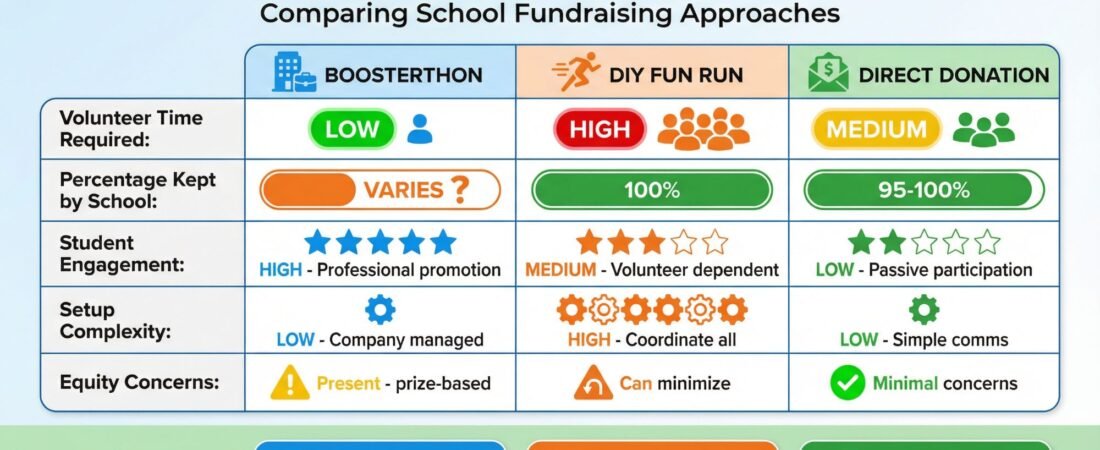
| Feature | Boosterthon | DIY Fun Run | Direct Donation Campaign |
|---|---|---|---|
| Volunteer Time Required | Low | High | Medium |
| Percentage Kept by School | Varies significantly based on contract | Nearly 100% | 95-100% |
| Student Engagement | High (professional promotion) | Medium (depends on volunteers) | Low (passive participation) |
| Setup Complexity | Low (company manages) | High (coordinate everything) | Low (just communications) |
| Equity Concerns | Present (prizes tied to donations) | Can be minimized by design | Minimal (no public prizes) |
| Best For | Low volunteer capacity schools | Strong volunteer base schools | Schools with engaged donors |
What Concerns Us About This Booster Fundraising Review
The equity issues came up in almost every conversation I had with parents from economically diverse schools. When prizes get distributed based on pledge amounts, kids immediately see which classmates come from families with more financial resources.
Some Boosterthon implementations hand out prizes daily in front of the entire class. Students watch their peers receive rewards while they get nothing, not because they didn’t try, but because their families couldn’t afford to donate as much.
Several parents described their children coming home upset because they felt left out. One parent told me her daughter cried because she wasn’t getting the prizes other kids received, and explaining the financial reality to a second-grader felt awful.
Schools can negotiate to minimize this by changing how prizes get distributed, but that needs proactive planning and firm boundaries with the company before the event starts.
The classroom time concerns teachers trying to protect instructional minutes. Boosterthon representatives visit classrooms daily during the two-week promotion period.
Some teachers appreciate the character education content, while others view it as lost learning time they can’t afford.
The intensity of the promotional campaign varies depending on how clearly your school sets expectations with Boosterthon upfront. Schools that let the company operate with minimal oversight reported more aggressive promotion tactics.
Schools that established clear boundaries about classroom access and promotional messaging had better experiences.
The social media pressure affects families differently. The donation model relies heavily on parents sharing their child’s pledge page on Facebook, Instagram, and other platforms.
Families comfortable with social media fundraising find this easy.
Families who don’t use social media often, prefer to keep their networks private, or feel uncomfortable asking for money online struggle with this format.
Who Should Consider Boosterthon
This Booster Fundraising Review suggests Boosterthon works best for schools in specific situations.
Your school fits this profile if volunteer recruitment has become nearly impossible. When the same five families handle every PTA responsibility and they’re exhausted, paying a company to manage a fundraiser makes practical sense.
Schools in communities where most families use social media actively will see better results with the online pledge system. If your parent population shares things on Facebook regularly, the donation page model works naturally.
You need strong administrative leadership willing to set boundaries with the company. Principals and PTA presidents who clearly talk expectations about classroom time, promotional tactics, and prize distribution can shape the experience significantly.
Schools without that leadership voice often experience the program in ways that create problems.
Your community has sufficient financial resources that asking for donations doesn’t create hardship. The model assumes families have disposable income and extended networks with means to contribute.
Schools serving predominantly low-income communities might find the approach doesn’t match their reality.
Who Should Skip It
Schools with active, capable volunteer bases can run their own fun runs and keep nearly all the money raised. If you have parents with event planning experience, teachers willing to coordinate, and a history of successful volunteer-led fundraisers, a DIY approach will net you significantly more money.
Communities where the equity concerns would create serious problems should look elsewhere. If making donation amounts visible through prize distribution will damage relationships or hurt students, the format doesn’t fit your values.
Schools that have found success with direct donation campaigns don’t need the complexity Boosterthon adds. Some PTAs send one well-crafted letter home explaining their funding needs, provide a simple online donation link, and get strong responses.
If that works at your school, it keeps more money in your budget.
The Alternatives Worth Considering
Several schools I interviewed had switched from Boosterthon to completely volunteer-run fun runs. They used free lap-tracking apps, recruited parent volunteers to manage setup, and kept nearly 100% of donations.
This needs real work and committed volunteers, but the financial difference can be substantial.
Direct giving campaigns work at schools with strong parent engagement and clear communication about PTA needs. You explain exactly what the money funds (library books, technology, field trips, teacher supplies), set a specific goal, and ask families to contribute what they can. Schools where this works well reported better outcomes than any event-based fundraiser.
Some PTAs negotiated hybrid arrangements with companies like Boosterthon. They reduced the company’s on-site presence, increased their own volunteer involvement, and got better rates as a result.
This takes negotiating confidence and willingness to do more work yourselves.
What the Contract Should Include Before You Sign
Request the contract in writing before committing to anything. You need to see the actual financial terms, not just verbal estimates.
The contract should specify exactly what Boosterthon takes as payment, whether that’s a flat fee or percentage. If it’s a percentage, that number needs to appear in writing.
Ask what happens if you don’t meet fundraising minimums and whether you’re obligated to pay regardless of results.
Clarify how many school days Boosterthon representatives will have classroom access. Get specific about what activities they’ll conduct during that time and how long each classroom visit lasts.
The prize distribution method should appear in the contract. Will prizes be handed out publicly or privately?
Can your school adjust this to minimize equity concerns?
What prizes get offered and how are they tied to donation amounts?
Ask whether you can review and approve promotional materials before they go home to families. Some schools were blindsided by aggressive messaging they wouldn’t have approved if they’d seen it first.
Get references from schools similar to yours in size and demographics. Talk to their PTA coordinators about their honest experience, including problems they encountered.
Our Final Take on This Booster Fundraising Review
Boosterthon solves a real problem for schools that genuinely lack volunteer capacity. If you can’t recruit enough committed volunteers to run a fundraiser yourselves, paying a company to manage it becomes your practical option.
The program raises money and creates a fun event that students enjoy. Those are legitimate benefits.
The concerns are also legitimate. The commission structure means you keep less than you would from a DIY approach.
The equity issues become visible in ways that can hurt students and damage community relationships.
The classroom time and promotional intensity might not match your school’s values or needs.
Your decision comes down to three questions. First, what volunteer capacity does your school actually have right now, not theoretically?
Second, what contract terms can you negotiate, and are those terms acceptable financially?
Third, how will the equity dynamics play out in your specific community?
Schools that answered those questions honestly before signing had better experiences than schools that made assumptions or accepted promises without getting specifics in writing.
If you have the volunteer capacity to run your own event, you’ll keep significantly more money by doing it yourselves. If you don’t have that capacity but need to raise funds, Boosterthon can work, but only if you negotiate a fair contract and set clear boundaries about implementation.
The schools most satisfied with this Booster Fundraising Review approach were those who knew exactly what they were getting into financially and operationally. They negotiated firm contracts, set clear expectations about classroom access and promotional tactics, and monitored the program actively during implementation.
The frustrated schools accepted standard terms, didn’t ask tough questions upfront, and discovered problems after commitments were made.
Your PTA deserves better than surprises. Get the contract details in writing, talk to references from similar schools, and make your decision based on your specific situation as opposed to generic promises.